About the Founder
The Person Behind the Corridor
Jean Bedard brings over 25 years of experience in international finance, cross-border treasury, and structured capital markets across the GCC and ASEAN regions. His career spans senior banking liaison roles with global financial institutions, structured finance origination, Sharia-compliant instrument design, and cross-border capital structuring for sovereign, corporate, and institutional counterparties — across common law (DIFC), civil law (KSA/SAMA), and civil-hybrid (ASEAN) jurisdictions.
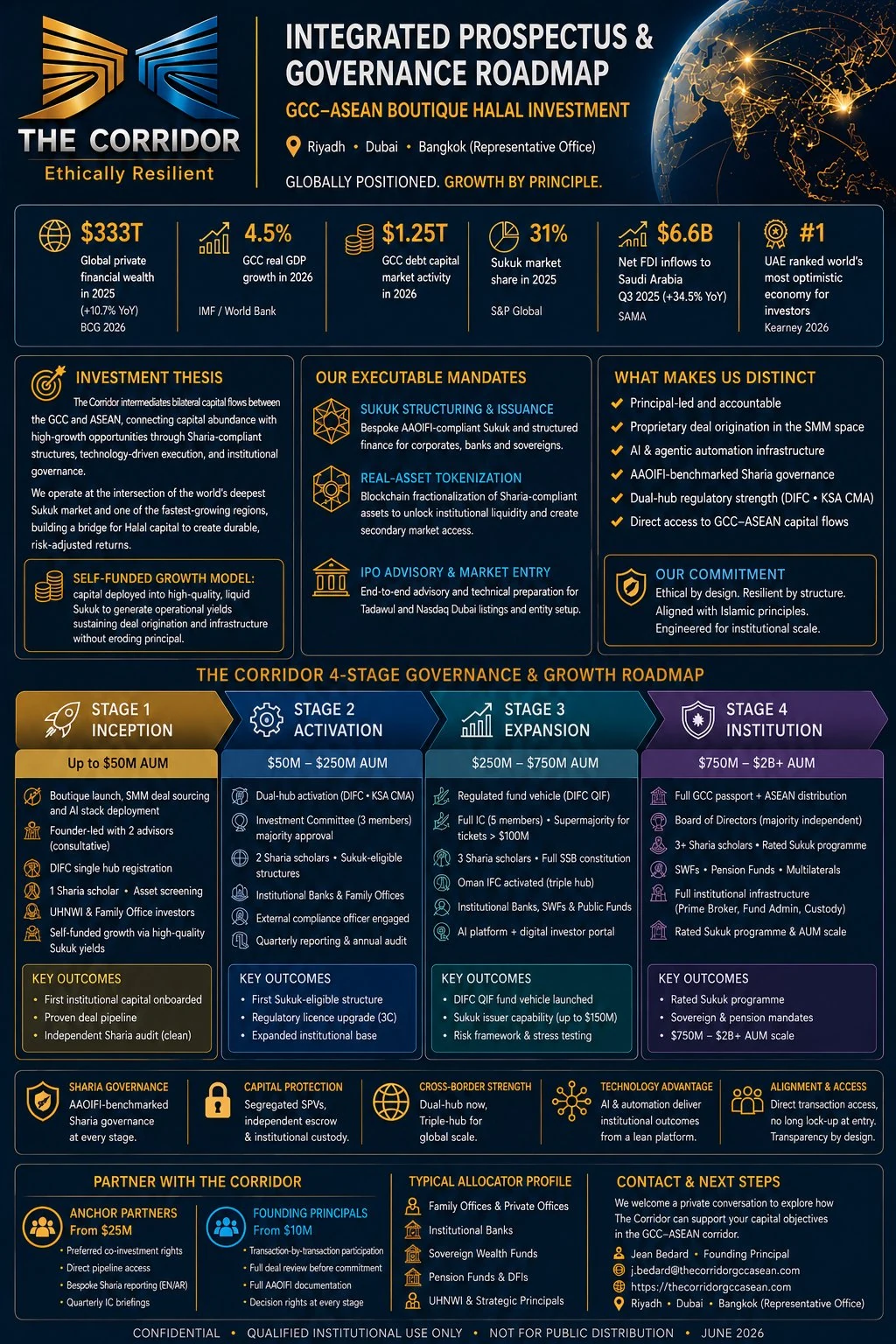
The Corridor is built on that network — relationships with deal-makers, regulators, Sharia scholars, and capital allocators across the GCC–ASEAN corridor — translated into a disciplined, principal-accountable investment vehicle. Currently based in Bangkok, The Corridor will progressively establish its regulatory footprint: DIFC registration targeted at Stage 1, KSA CMA activation at Stage 2, and full dual-hub operation from Stage 2 onward.
Jean leads all mandate origination, investor relations, and Sharia governance coordination personally — supported by two independent senior advisors under documented engagement letters. The model is deliberate: principal-led and accountable, proprietary deal origination in the SMM space, and direct transaction access for every partner rather than blind fund exposure.
Why The Corridor Exists
The GCC–ASEAN corridor is one of the most capital-intensive bilateral relationships in global Islamic finance. GCC sovereign and institutional capital — estimated at over $3.5 trillion — is seeking diversification into ASEAN's high-growth markets, where Sukuk-eligible fixed income, tokenized asset structures, and capital markets listings offer multi-decade return profiles consistent with Islamic finance principles.
The Corridor is structured to intermediate this flow — sourcing mandates across ASEAN (primary origination focus: Thailand, Indonesia, Malaysia, and Vietnam), packaging them into AAOIFI-benchmarked structures, and distributing to GCC and international Halal-mandate allocators. Differentiation comes from bilateral network depth, Sharia compliance rigour, deployable AI and agentic automation, and the ability to operate across DIFC (common law), KSA/SAMA (civil law), and Oman IFC (neutral settlement) jurisdictions.
A Governed Build — Four Stages
The four-stage governance framework ensures that regulatory infrastructure, custodian arrangements, and Sharia supervisory capacity scale proportionally with assets under management. Governance is always ahead of the capital — not behind it.